
 Go Premium

In summary:
• The mega trade deal between the USA and Taiwan aims to enhance the semiconductor sector.
• NVIDIA’s stock price rose again on the deal and its supplier, TSMC.
• TSMC is becoming the main supplier and the best opportunity for NVIDIA to achieve more efficient and lower-cost production.
• Risks include reliance on TSMC in the supply chain, geopolitical tensions with China, and market volatility.

As the U.S. The Commerce Department stated that the U.S. and Taiwan, after a long negotiation process, clinched a trade deal on 15th January that cuts tariffs on Taiwanese goods to 15% from 20% and directs new investments into the U.S. technology industry. (Reuters)
NVIDIA, a computing infrastructure company, which provides graphics and compute, and networking solutions in the United States, Singapore, Taiwan, China, Hong Kong, and internationally, benefits from this deal as one of its main suppliers TSMC (32.81%), Taiwanese chipmaker, and Wistron Corp (17.69%) will pay less tax when exporting semiconductors to the U.S. (Moomoo)
On the supplier side, NVIDIA’s main suppliers are TSMC (chip manufacturing), SK Hynix and Micron (memory), ASE Technology and Amkor (packaging/testing), Wistron and Flex (assembly), and equipment providers such as ASML and Applied Materials. Among NVIDIA’s foreign revenue generators, Taiwan is one of the largest, contributing $20.5 billion (Gurufocus), while TSMC is also one of the main suppliers, accounting for 13.05% of TSMC’s revenue.
China is the next major revenue source for NVIDIA, but this mega trade deal could be a negative signal for NVIDIA’s Chinese suppliers. In addition, NVIDIA’s primary chip manufacturer, TSMC, provides high-performance GPUs and CPUs, proprietary Chip-on-Wafer-on-Substrate (CoWoS) packaging, and other critical products. Moreover, Taiwan’s plan to invest $250 billion in the U.S. semiconductor sector is a positive signal for NVIDIA’s current situation and its potential stock price changes. (Reuters)
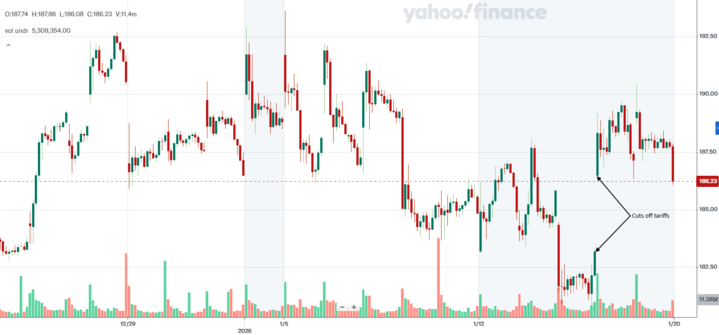
As a result of the deal between the two countries, NVIDIA’s stock chart shows upward momentum, leading to a positive market reaction. NVIDIA’s stock price was $183.33 and peaked at $187.49, up 2.27% on the day. (Yahoo finance)
This deal also impacts NVIDIA investors in both positive and negative ways:
• Tariff reductions and supply-chain commitments may lead to higher production and lower costs.
• Dependency on TSMC remains a key risk and opportunity.
• Competitors such as Intel and AMD may benefit from these investments to expand the U.S. semiconductor sector.
Sources:
- NVIDIA Historical Stock Price & Trading Data — https://finance.yahoo.com/quote/NVDA/history/ (Yahoo Finance)
- U.S.–Taiwan Reach Semiconductor-Focused Trade Deal — https://www.reuters.com/world/china/us-taiwan-reach-trade-deal-focused-semiconductors-commerce-department-says-2026-01-15/ (Reuters)
- NVIDIA Financials & Segment-Level Revenue Breakdown — https://www.gurufocus.com/stock/NVDA/financials#segment_data (GuruFocus)
- NVIDIA Supply Chain Ecosystem & AI Infrastructure Partners — https://www.moomoo.com/community/feed/nvidia-s-supply-chain-empire-who-powers-the-ai-s-114771677478918 (Moomoo Community)

Disclaimer: The content is for informational purposes only and does not constitute legal, investment or financial advice.
It is important to conduct your own research or consult with a financial or investment advisor. Past performance is not indicative of future results. All logos or brands are referenced for identification purposes only and do not constitute an endorsement of any kind. This information is accurate as of the date of publication and may not reflect recent changes. Access our comprehensive legal disclaimers at https://musaffa.com/disclaimer.