Foundations of Halal Investing
Learn the core principles of halal investing and how Islamic finance guidelines apply to real-world investing decisions.
This course includes
1-hour live, one-on-one session with an expert financial analyst
Personalized guidance and time for questions
Access to the class recording for 30 days
Clear next steps for continued learning on Musaffa
Verified digital certificate of completion

Learn the core principles of halal investing and how Islamic finance guidelines apply to real-world investing decisions. In this course, you will understand what makes a stock or ETF Shariah-compliant, what types of business activities are screened out, and how common financial ratios (such as debt and interest-based income) affect compliance status.

You will also learn how purification works, why compliance can change over time, and how to build a long-term halal portfolio using diversification and risk management. This foundation helps you invest with confidence, avoid common mistakes, and understand how halal investing differs from conventional investing before placing your first Shariah-compliant investment.

Schedule & Enrollment: Investing Fundamentals
 
Friday, February 06
Please select a time to enroll in the course
Meet Your Instructor
Doniyor Akhmadjonov
Doniyor Akhmadjonov
Head Financial Analyst
Doniyor is the General Director of Musaffa’s subsidiary in Uzbekistan, overseeing operations, strategic execution, and regulatory alignment. He manages core functions including equity research, compliance, and organizational development, ensuring full integration with Musaffa’s global fintech network. With over five years of experience in commercial banking and Islamic fintech, he brings strong financial, operational, and regulatory expertise. Doniyor holds a BSc in Economics with Finance from the University of Westminster and is passionate about advancing ethical finance, Islamic fintech innovation, and inclusive leadership.
Course Syllabus
Topic 1
Islamic Finance Rules for Investing
  • What makes investing halal vs. haram (principles only)
  • Riba (interest) and where it appears in modern investing
  • Gharar (excess uncertainty) and why it matters
  • Haram industries and “mixed activity” businesses
  • Practical meaning of Shariah compliance (what investors actually do differently)
Topic 2
How Shariah Screening Works
  • The two-part screening model: business + financial
  • Who sets the rules (Shariah boards, screening standards)
  • Why results differ between screening providers
  • What “compliant”, “non-compliant”, and “watchlist” mean
  • How often compliance is reviewed and updated
Topic 3
Financial Ratios Used in Screening (Practical View)
  • Debt-related thresholds (high level, not math-heavy)
  • Interest income and non-permissible revenue thresholds
  • Interest-bearing assets/Market Capitalization ratio logic (why it matters)
  • What typically causes a company to fail screening
  • Simple examples: “passes vs. fails” patterns
Topic 4
Purification & Dividends (What You Need to Do)
  • What purification is and why it exists
  • When purification is required (dividends, capital gains)
  • How purification is estimated (conceptual approach)
  • What happens if you don’t purify
  • Simple process to stay consistent without stress
Topic 5
Halal Portfolio Construction
  • Halal asset types: stocks, ETFs, sukuk overview
  • Diversification rules of thumb for halal portfolios
  • Concentration risk (especially in “halal-only” lists)
  • Rebalancing and keeping compliance in mind
  • Building a long-term plan you can stick to
Topic 6
Real-World Scenarios & Mistakes to Avoid
  • “It became non-compliant” — what to do next
  • “I bought a stock and later found it’s haram” — response options
  • Avoiding hype and overtrading (common pitfall)
  • Why “halal” does not mean “safe” or “guaranteed”
  • Checklist before investing (compliance + risk + diversification + fundamentals)
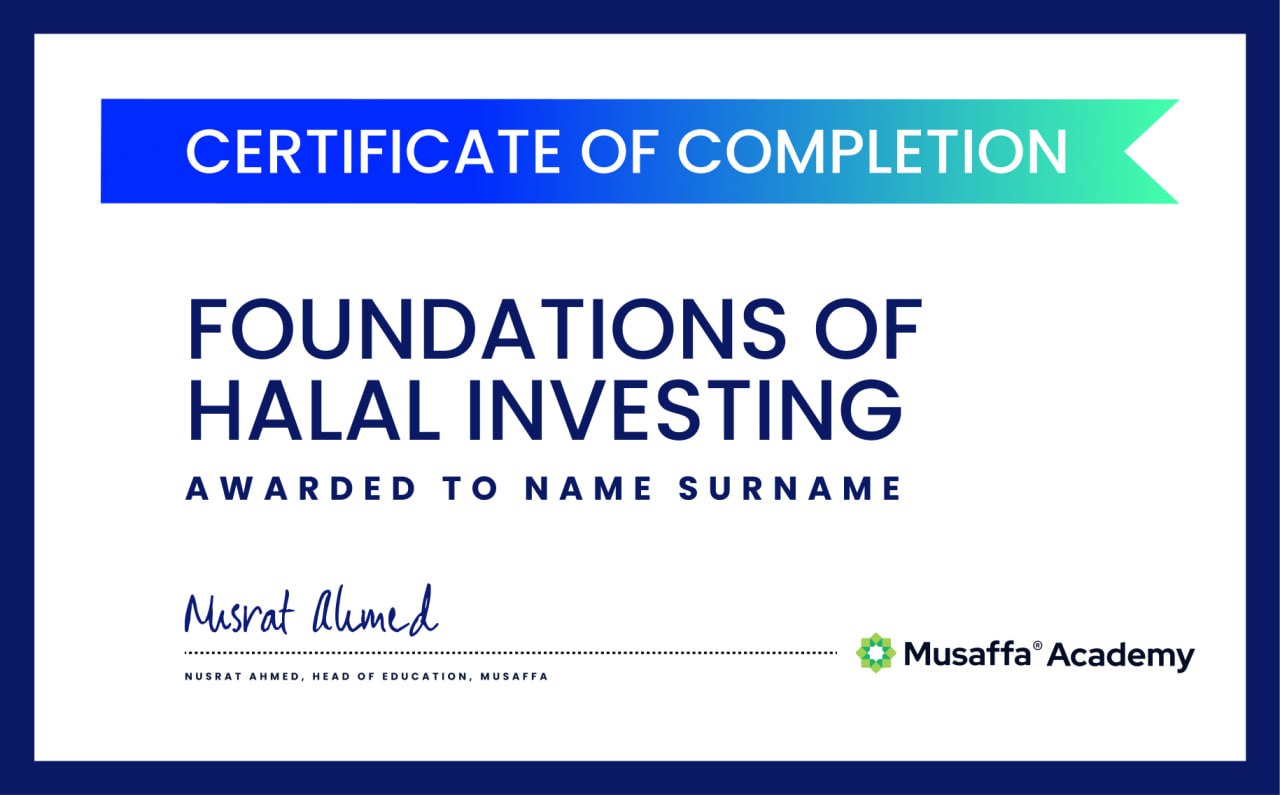
Earn a Certificate of Completion
Complete the course to receive an official certificate recognizing your achievement. Download it anytime and share it on LinkedIn.
Certificate
Enrollment Details
Price
$99
Due before the class starts
How Pricing Works
Pay once for a private 1-on-1 session
No commitment or subscription required