




For many years I wanted to learn how to invest.
Like many beginners, I did not know where to start. I tried several different things before I discovered what works for me.
Some of those attempts were successful. Some were expensive mistakes.
In this article, I want to share my personal journey and how I eventually started halal investing in stocks and ETFs.
If you are a beginner Muslim investor, my hope is that my story will help you better understand how halal investing works in real life.
What Is Halal Investing?
Halal investing means investing in financial assets that follow Islamic principles.
This usually means avoiding:
- interest (riba)
- gambling businesses
- alcohol companies
- pork-related industries
- other prohibited activities
Instead, Muslim investors focus on Shariah-compliant stocks and ETFs that follow Islamic financial rules.
Today there are tools and platforms that help Muslim investors identify these investments more easily.
My First Investment: Real Estate in Odessa
My first investment was an apartment in Odessa, Ukraine.
Odessa is a beautiful city on the Black Sea. Right now the country is going through war. Despite that difficult situation, the apartment has already doubled in value since I bought it.
Today my mother lives in that apartment. It was always her dream to live there, and she is very happy.
Even during the war, the value of the apartment has grown about two times. Personally, I believe that once the war ends and the country rebuilds, the value could increase four or even five times more over the long term.
Cities located on the seaside often become very attractive places to live and invest.
But real estate also has some problems.
It is difficult to sell quickly.
There are taxes, paperwork, and sometimes even fraud risks.
Because of that, I started looking for other ways to invest.
My Second Attempt: Rent-to-Rent Apartments in the UK
My second attempt at investing was rent-to-rent apartments in the United Kingdom.The rent-to-rent model works like this:
- You rent an apartment from a landlord.
- You rent it out again to short-term tenants.
- You try to earn the difference.
In theory, it sounds like a great business.
In reality, for me it was a complete disaster.
I lost tens of thousands of pounds trying to make this model work.
The biggest problem is that rent-to-rent requires constant work:
- Cleaning
- Maintenance
- communicating with tenants
- solving unexpected issues
Unless this is your full-time job and you live near the property, it becomes extremely difficult to manage.
Instead of becoming a passive investment, it becomes a full-time responsibility.
That experience taught me an important lesson:
Some investments look easy, but actually require a lot of daily work.
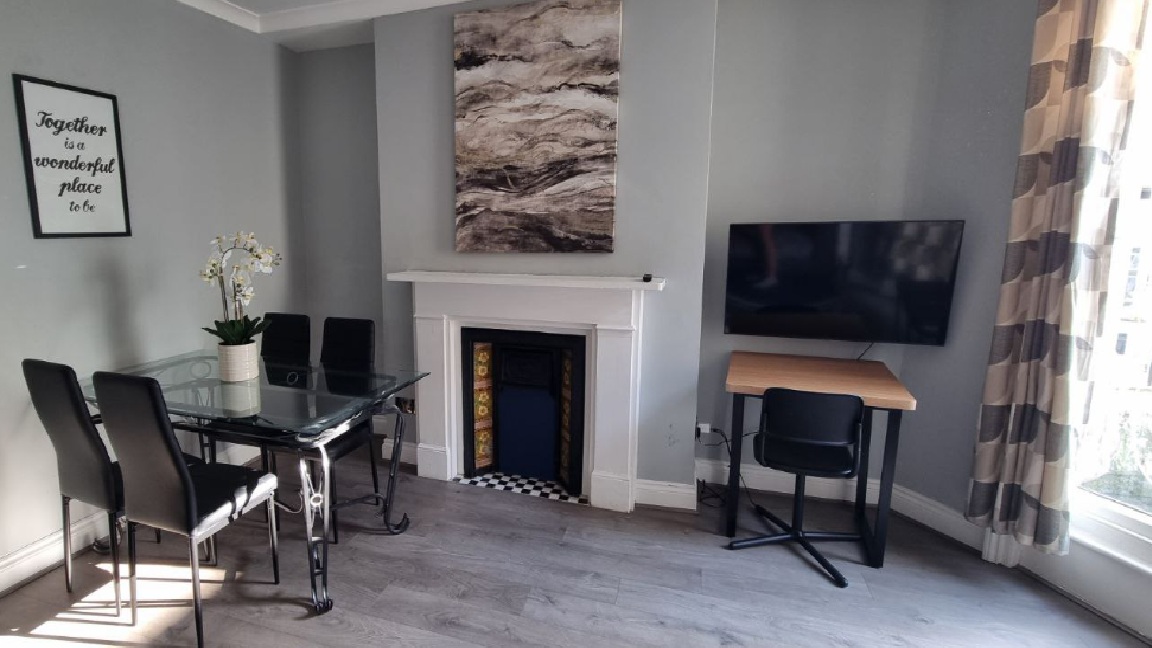
The picture of the apartment in Brighton and Hove that I used for rent-to-rent
Discovering Stocks and ETFs
After that experience, I started researching stocks and ETFs.
That is when I realized how powerful financial markets can be.
You can invest in many different assets through financial markets, including:
- real estate funds
- gold funds
- technology companies
- entire stock markets
One example surprised me the most.
At one point I wanted to invest £5,000 into physical gold.
But buying physical gold turned out to be very complicated.
There were many problems:
- dealer commissions when buying
- dealer commissions when selling
- storage problems
- taxes
- restrictions on transporting gold between countries
Because of all this hassle, I decided not to buy physical gold.
Later I discovered something important.
Instead of buying physical gold, I could buy a gold ETF.
A gold ETF is a fund that holds real gold and tracks its price. Investors simply buy units of the fund.
If I had invested £5,000 into a gold ETF at that time, it would be worth over £20,000 today, because the price of gold has increased significantly.
This discovery completely changed how I think about investing.
The Next Challenge: How to Invest in a Halal Way
Once I understood stocks and ETFs, I faced a new question.
How can I invest in a halal way?
Many large investment platforms offer thousands of financial instruments. But they often do not clearly explain:
- whether something is halal or not
- whether leverage is involved
- whether interest is part of the transaction
For a Muslim investor, this creates uncertainty.
I wanted to make sure that my investments follow Islamic financial principles.
That is when Musaffa became extremely useful.
How I Used Musaffa to Start Halal Investing
Musaffa provides tools that help Muslim investors find Shariah-compliant stocks and ETFs.
I used the Musaffa screening tool to search for investment opportunities.
I also used ChatGPT as a guide to help me apply filters and narrow down my options.
Using these tools, I filtered out investments that I considered too risky and focused mainly on ETFs that matched my criteria.
I will not share the exact filter settings that I used.
The reason is simple: I do not want to give anyone the impression that I am telling them what to buy.
Everyone should do their own research and make their own decisions before investing.
Musaffa provides many educational resources that help investors learn how to screen stocks and ETFs properly.
My First Small Investment Experiments
After I bought my first ETFs, I wanted to experiment a little.
I bought small amounts of different investments:
- $10 of one stock
- $20 of another company
- small portions of several ETFs
In total, I invested about $150.
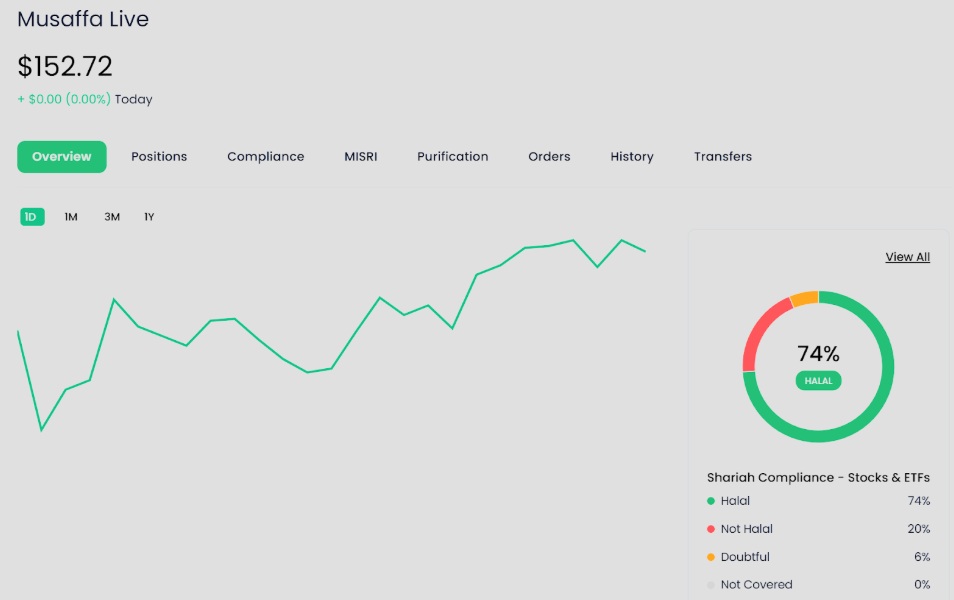
My current investment portfolio with Musaffa. I am up $2.72 in about a month. It was more but due to the war in Middle East it went down.
I fully understood that this money could lose value.
But my goal was not profit.
My goal was experience.
I wanted to understand how the platform works, how trades happen, and how investing feels in practice.
For learning purposes, this was extremely valuable.
Funding My Investment Account
For someone living in the United States or the United Kingdom, funding an investment account can be simple and inexpensive.
But I live in Moldova, and currently there are no local payment rails available for funding the account.
Because of that, sending $150 cost me about $17 in transfer fees.
That is more than 10 percent, which is obviously not ideal if your goal is profit.
But again, my intention was not to make money from this first investment.
My goal was to test the process and gain experience.
Musaffa operates under SEC oversight, which means the platform must follow strict financial regulations. That gave me confidence that the funds are handled properly.
How Beginners Can Start Halal Investing
If you are new to investing, the process can be simpler than it seems.
Here are a few basic steps to start halal investing:
- Learn the basic principles of halal investing.
- Use a halal stock screening tool.
- Start with small investments to gain experience.
- Diversify your portfolio with stocks and ETFs.
- Continue learning and reviewing your investments.
Starting small can help you build confidence and experience.
Final Thoughts
I am still early in my investing journey.
But the biggest lesson I learned is simple:
You do not need a lot of money to begin investing.
Sometimes investing a small amount just to learn can completely change how you think about your financial future.
If you are interested in halal investing, take the time to learn, explore different options, and always do your own research before making investment decisions.
That first step can make a big difference.

Disclaimer: Musaffa Academy articles are provided for informational purposes only, and are not research reports or legal, tax, investment, or financial advice. Content may include historical or hypothetical data; past performance does not guarantee future results.
Stock screenings, halal status, grades, and classifications are based on AAOIFI methodology and the oversight of Musaffa’s Shariah scholars. The content is not tailored to your financial situation, risk tolerance, or investment objectives. Always conduct your own research or consult a qualified financial advisor before making decisions.
Musaffa Islamic Social Responsible Investing (MISRI) proprietary rankings are internally developed by Musaffa and are currently in beta. While we continuously work to improve accuracy and reliability, no guarantees are made regarding completeness or correctness.
Logos and brand names are used for identification only and do not imply endorsement. Information is accurate as of the publication date and may change. All content, materials, and methodologies are the exclusive property of Musaffa and are protected by copyright law.
For full details, please visit: https://musaffa.com/disclaimer
 Danesh Ramuthi

 Nusrat Ahmed